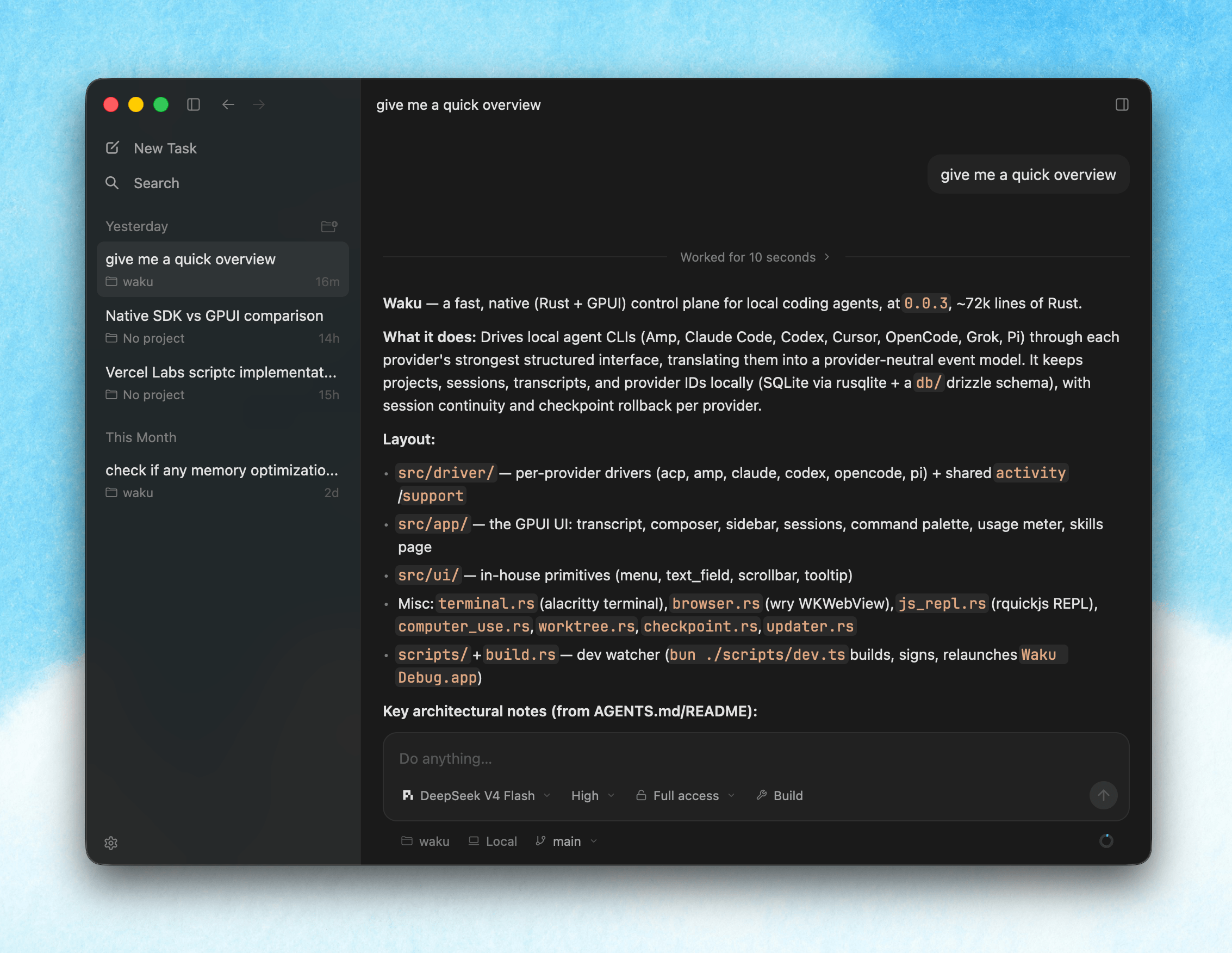
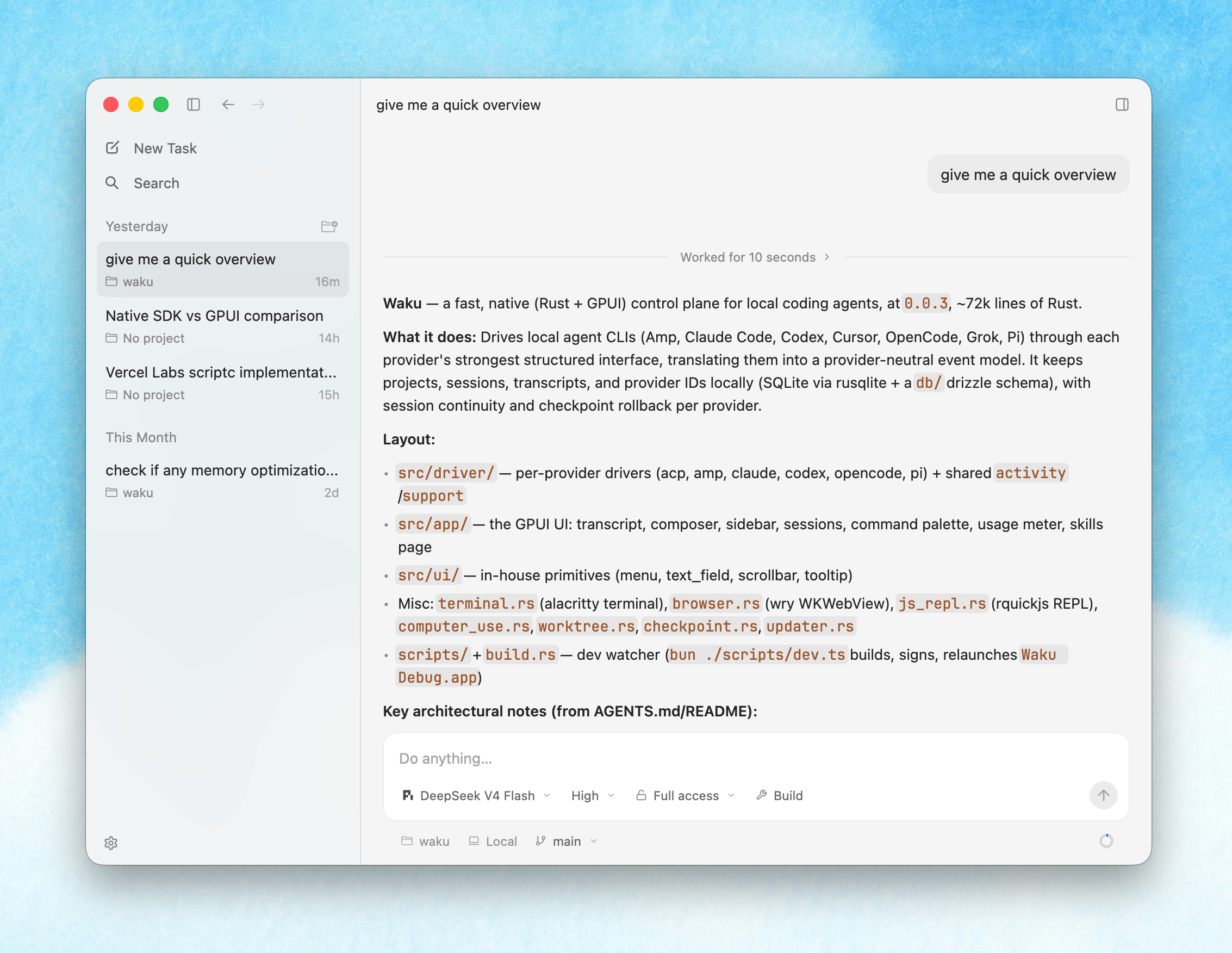
One window for fourteen coding agents.
It drives the agent CLIs already on your machine, over their own protocols, with your sessions and transcripts on your own disk.
Drives the agents you already use
- Form factor
- One native binary. Rust and GPUI, no browser engine.
- Platforms
- Windows x86_64 · Windows arm64 · Android (building)
- Agents
- 14 providers over their own native protocols
- Session model
- One long-lived process per conversation
- Storage
- Local. SQLite, blob store, your user profile.
- Updates
- In place. Windows and Android check a feed on launch.
- Licence
- GPL-3.0-only
- Origin
- A fork of an open-source GPL project
Straight answers
What is this?
A native desktop app for running and managing local coding agents. One window holds your projects and their sessions.
GPUI, the GPU-accelerated framework behind Zed, draws the interface from a single Rust binary. No browser engine runs inside it.
Do I need new API keys or subscriptions?
No. Kerenzikov drives the agent CLIs already installed and authenticated on your machine. It finds each binary on launch and talks to it, so your existing logins and rate limits apply unchanged.
How does one app drive fourteen agents?
Kerenzikov reaches each provider through its strongest native interface: stream-json, JSON-RPC, the Agent Client Protocol, HTTP with server-sent events, or NDJSON. It normalizes all of them into one provider-neutral model.
Each agent keeps its own context when you switch providers mid-project.
What happens when an agent edits my code?
Kerenzikov checkpoints your working tree under a hidden git ref before each prompt. When you roll back, the code and the provider conversation return to that point together, so they stay in step. You can also branch from an earlier turn.
Where does my data live?
On your disk. Tasks and transcripts go in a local SQLite database, attachments in a blob store, and settings in your user profile.
Your data does not pass through any server we run.
Can I drive it without a mouse?
Yes. Ctrl+N starts a session, Ctrl+Tab switches tasks, Ctrl+L focuses the composer, and Escape stops a turn. Enter queues a follow-up while the agent works; Ctrl+Enter steers the turn already in flight.
Controls are reachable from the keyboard, and focus stays visible.
Does it phone home?
Only if the build includes an analytics endpoint, and then only coarse events: app version, platform, and which provider ran.
Prompts, file paths, project names, and provider output stay on your machine. The switch is in Settings.
What about macOS and Linux?
Not built here. This fork targets Windows. The macOS-native desktop code is still in the source tree, but no one maintains or ships those builds, so treat them as unavailable rather than broken.
If you are on macOS or Linux, use the upstream project. The link is in the footer.
Is this a fork?
Yes. It is a fork of an open-source GPL-3.0 coding-agent client, tuned here for Windows, with OpenCode as the best-supported provider. Upstream is credited in the footer.
How do updates work?
The first install is manual. After that, the Windows build checks a signed update feed on launch and replaces itself in place, and the Android build checks a release manifest and hands the new APK to your installer.
Both checks can be turned off in Settings, and a release installs only when you accept it.
Get Kerenzikov
A per-user installer for Windows, a portable archive beside it, and an arm64 build for ARM machines. The Android companion ships as a universal APK. Install and authenticate at least one agent CLI first; Kerenzikov drives those, it does not replace them. This first install is the manual one: the Windows and Android builds update themselves from here on.